
Two Standards -- Questionable Iranian Institution Expands in Georgia While Georgian Universities Are Dismantled
An institution with links to the Iranian Revolutionaly Guard Corps and credibly linked to killings seems to thrive in Georgia, with little transparency, according to a new report.
A summary of Georgia’s Iranian Turn by Giorgi Kandelaki and Luke Coffey (Hudson Institute, March 2026
A new report from the Hudson Institute, authored by Giorgi Kandelaki — former Georgian MP and project manager at the Soviet Past Research Laboratory — and Luke Coffey, senior fellow at Hudson, documents the systematic expansion of Iranian influence in Georgia. For readers concerned with Georgian higher education, one dimension of the report deserves particular attention: the contrast between what the Georgian Dream government is doing to Georgia’s own universities and what it is allowing to happen within its borders under Iranian auspices.
The Iranian Educational Footprint
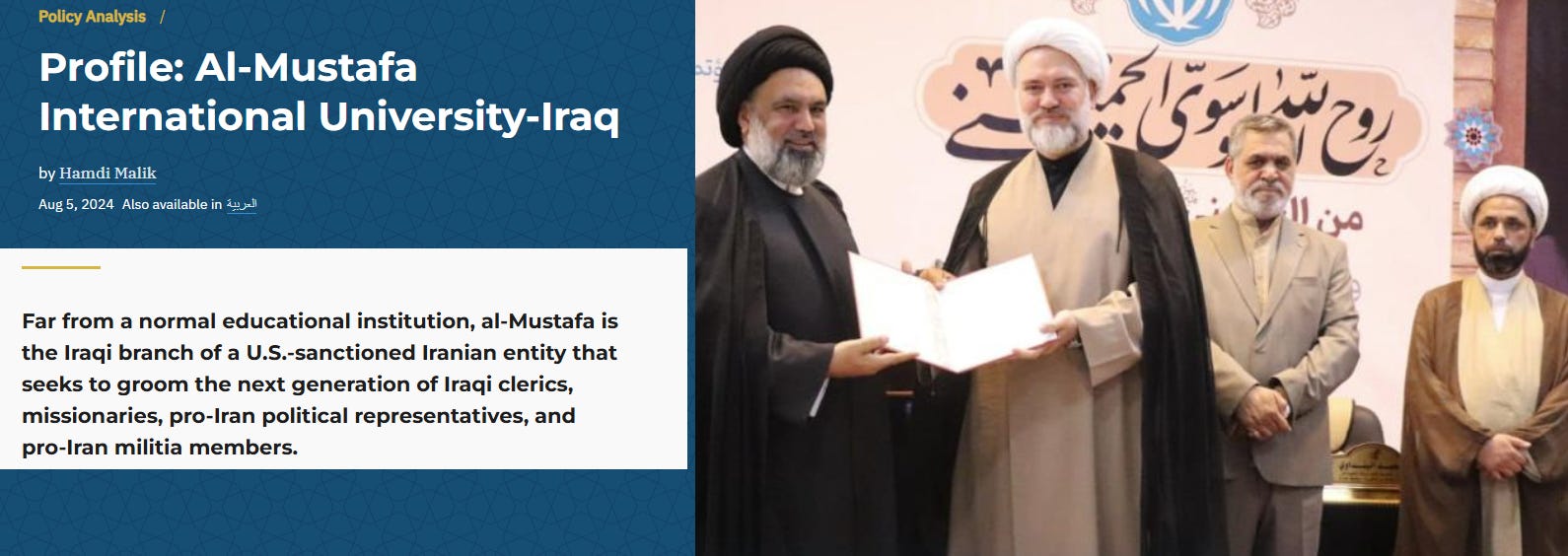
The report documents in considerable detail the operations of Al-Mustafa International University (AMIU) in Georgia — a religious school sanctioned by the United States Treasury Department in 2020 for extremism and facilitating IRGC intelligence operations and using its student body as an international recruitment network. Canada sanctioned it in 2022 for regularly recruiting students into the Quds Force. The Foundation for the Defense of Democracies, a Washington-based think-tank characterizes Al Mustafa as “Iran’s terror front.”
These are not abstract claims: the head of AIMU’s department focusing on Spain and Portugal, Mohsen Rabbani, is reported to be implicated in the attack on an Israeli Culture Center in Buenos Aires in 1994 which killed more than 80 people, while another, Seyed Mojtaba Hosseini Nejad, was recently directly linked with an assassination attempt on the Israeli Ambassador in Mexico. Nejad appears to be the representative of AIMU in Venezuela.
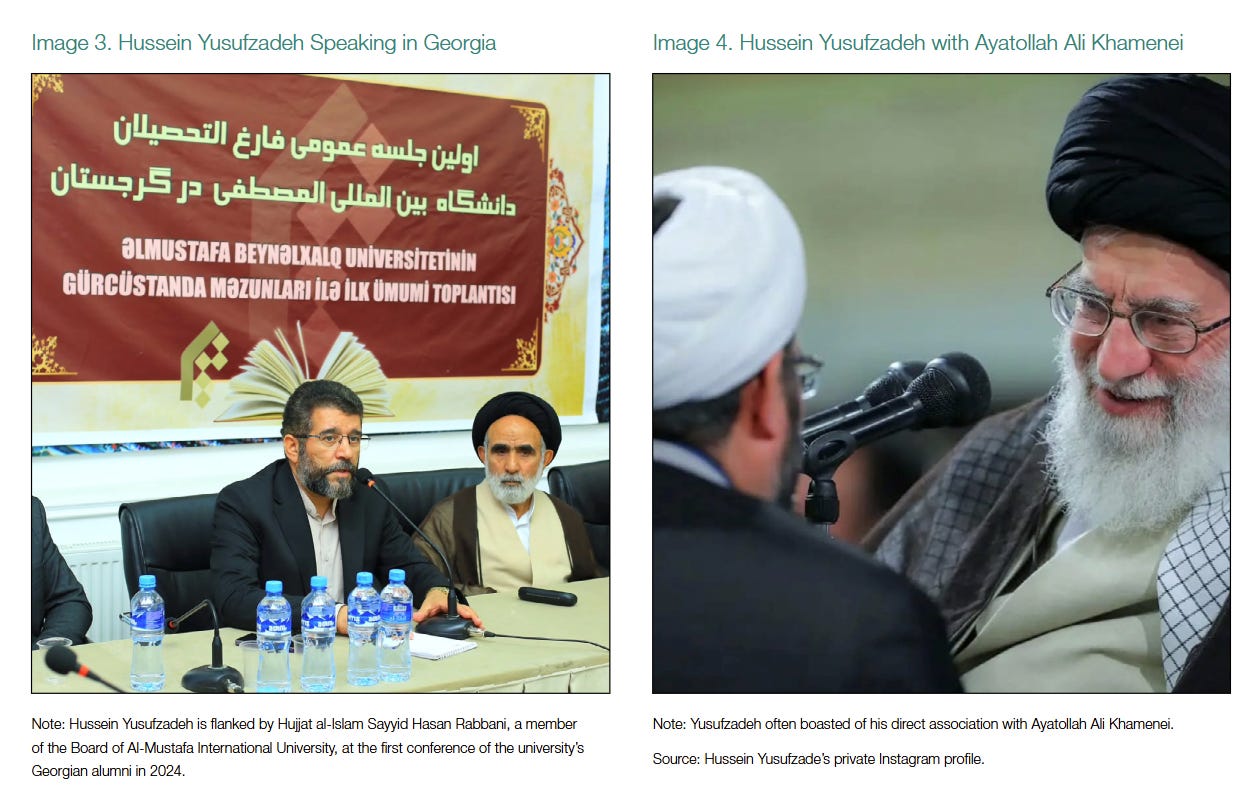
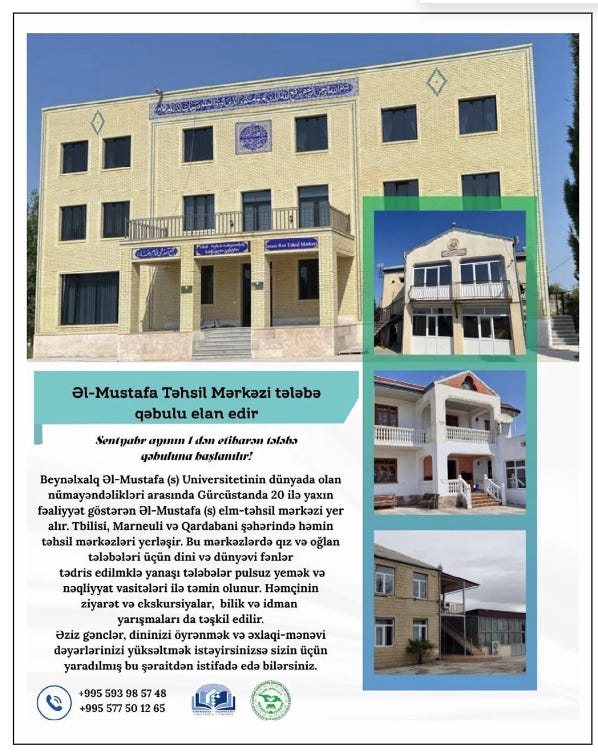
Despite these concerning involvements, AMIU operates three campuses in Georgia — in Tbilisi, Marneuli, and Gardabani — offering free meals and accommodation to students, running graduation ceremonies, and cultivating a growing alumni network. Over 120 graduates gathered at its inaugural alumni event in 2024.
The institution has never been registered as an accredited higher educational institution in Georgia — reportedly, the authors suggest, to avoid standard authorisation requirements. Yet it functions and presents itself publicly as a university and celebrates graduation ceremonies with diploma-style certificates. The Georgian State Agency for Religious Affairs, part of the Prime Minister’s Office, has received its delegations, hosted its leadership, and visited its headquarters in Qom. According to a former official of the Agency cited in the report, AMIU could not function in Georgia without the explicit consent of the State Security Service.
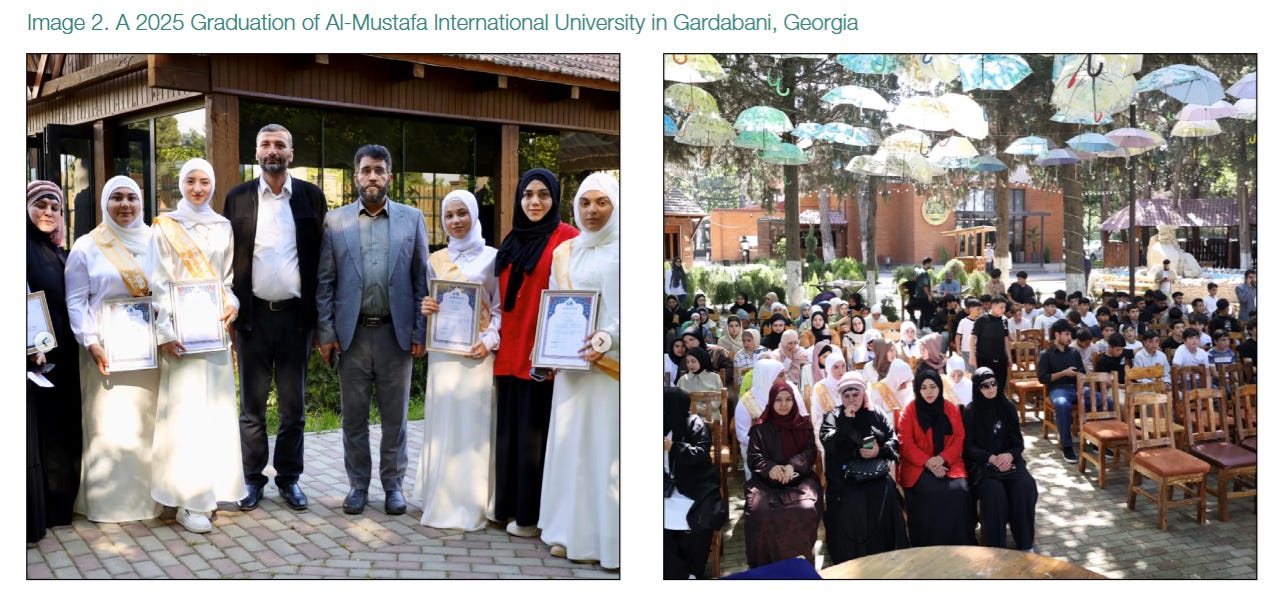
Some of the images from the report are striking: a graduation ceremony at the Gardabani campus, with students wearing sashes clearly marked “Al-Mustafa International University — Georgia”; senior figures of AMIU Georgia directly connecting with some of the most senior figures of the Iranian leadership, including Ayatollah Khamenei; meetings with various Georgian officials. This is a US-sanctioned institution, operating openly, with apparent state tolerance.
Open for Iranian Institutions while Closing Georgia’s Successful Universities
The free operation of AMIU stands in sharp contrast with aggressive stance of the Georgian Dream government towards Georgia’s own higher education sector. As documented separately on Ganatleba, the Georgian Dream government has imposed a sweeping restructuring under the so-called “One City — One University” concept. Ilia State University — long distinguished by its commitment to academic freedom, its internationally ranked research programs, and its insistence on scholarly independence — is effectively being dismantled, reduced to two areas of study. Its law faculty, liberal arts programs, and natural sciences departments are being eliminated, despite those departments holding the strongest international rankings of any Georgian university.
The rector of Ilia State, Nino Doborjginidze, described the move as “dismantling higher education” and eliminating “the most internationally successful fields.” Georgia’s constitution is unambiguous on this point: Article 27 guarantees the autonomy of higher educational institutions. The reform, as Ganatleba noted, is straightforwardly unconstitutional.
The minister responsible for these changes, Givi Mikanadze, has a professional background primarily in the police and penitentiary services, and has been reported to have falsely claimed a doctorate from a Dutch university.
No Transparency of Iranian Funding
The Hudson Institute report does not address Georgian university reform directly, and Kandelaki and Coffey’s focus is on Iranian influence and US strategic interests. As an analytic matter, however, the juxtaposition is hard to ignore: the Georgian Dream government is dismantling institutions associated with Western academic standards and independent scholarly culture, while permitting — and in some respects actively cooperating with — an Iranian-linked educational network that US and Canadian authorities regard as an instrument of political indoctrination and intelligence recruitment with some of its officials involved in terrorist activity.
On top, the funding for the university’s sizable operation in Georgia as well as other Iranian organizations remains highly dubious while Georgian Dream cracks down on western funding for civil society, with anyone accepting a grant from, let’s say, the European Commission facing up to six years in jail.
Whether one fully accepts the report’s framing of Georgia’s drift as an intentional strategic realignment or reads it as a more opportunistic accommodation of outside actors, the educational dimension of this picture warrants serious attention from anyone invested in the future of Georgian higher education.
Coda — Threats against Those Speaking out
It is also remarkable how the Georgian Dream has reacted to these concerns: by threatening those who have highlighted the presence of IAMU in Georgia, rather than dealing with the substance of the charges.
The threats focused on Kandelaki and Tina Khidasheli, a former minister of defense, who now leads a think tank, Civic IDEA, that has published a report on the financial links between Georgia and Iran. Khidasheli’s work had also been cited in a FoxNews piece from April 10, here.
Next to multiple other attacks (one government aligned station accusing the authors of a “campaign against Georgia”, Rustavi2, here; another calling for criminal charges, Imedi TV, here; description of Kandelaki and Khidasheli as “street scum” and “parasitic worms”, again on Imedi TV, here; and as traitors and saboteurs, here), a senior GD figure and mayor of Tbilisi, Kakha Kaladze called the Iran-related the Hudson Institute and Civic IDEA reports on the Iranian influence in Georgia a “hostile activity against the country”, added that the authors were “ordinary traitors”, and said “relevant agencies should be interested.”
Within a day, Georgia’s State Security Service launched an investigation on the alleged fact of “assisting foreign power in hostile activity” and summoned both Kandelaki and Khidasheli for interrogation.
Georgia’s Iranian Turn is available in full at hudson.org here: https://www.hudson.org/foreign-policy/georgias-iranian-turn-tehrans-rapid-expansion-influence-once-committed-us-ally-luke-coffey