
Policy Note -- "Centralization and Privatization: Georgia’s 2025 Education Reform and Its Societal Impacts"
Simon Janashia of Freedom Square on how the restructuring will limit higher education.
This Policy Note has been prepared by Simon Janashia of the Freedom Square party and has also been circulated among Georgia’s international partners. It offers a comprehensive overview on the motivations and key features of the proposed restructuring of Georgia’s education system.
26 December, 2025
On October 16, 2025, Prime Minister of the Georgian Dream (GD), Irakli Kobakhidze, unveiled the concept of the education reform. The aim of the reform was explained earlier, on May 22, 2024, in an interview with the popular anchor of the Public Broadcaster of Georgia, Giorgi Gvimradze (see below). In the interview, Mr. Kobakhidze argued that the government preceding Georgian Dream undermined the Georgian education system to advance the so-called “pseudo-liberal ideology”.
According to Kobakhidze, “this ideology aims to prevent youth from receiving necessary knowledge, and to strip them of their values”. To achieve this goal, the government headed by Mr. Saakashvili supposedly filtered professors for the public universities in Georgia, so that they a) have low qualifications and are b) politically biased. Mr. Kobakhidze argued for the need for an education reform that would take care of these deficiencies. He admitted that such reform would resonate with similarly negative public feedback, as the laws introduced in the same year targeted media and NGOs.
Based on our analysis of the GD rhetoric and the proposed actions, the so-called education reform pursues two main goals: a) to establish tight political control over education in Georgia and b) to privatize the education system in favour of local business interests.
The establishment of political control over the higher education system in Georgia is to be done by limiting the academic, administrative, and financial autonomy of Georgian Universities. You will find below key areas to be “reformed” by the Georgian Dream Party.
Limiting of Academic Autonomy
The public universities in the capital city of Tbilisi will be allowed to implement an academic program only if no other public university is teaching the same program in the same city. E.g., currently one could study law in Georgian Technical University, Tbilisi State University, Ilia State University, or Sokhumi State University. After the proposed changes, one would be able to study law only at one public institution, most likely Tbilisi State University. According to Mr. Kobakhidze, public universities will be limited to teaching “traditional programs”, referring to the programs that those universities were originally teaching before the liberalization of the higher education curricula before 1990s.
In the public universities outside the capital, only those situated in Kutaisi will be allowed to have multiple programs. All others, e.g. in Batumi, Akhaltsikhe, Telavi, Gori and Zugdidi will be allocated the right to teach only on two programs: teacher preparation and agriculture.
The government intends to change the required length of the programs as well. The length of the BA will be reduced from 4 to 3 years of study. The MA will be reduced from 2 to 1 year of study. The exceptions may be made to medical programs or any other regulated programs if the government allows for it. The number of years of study in public schools will also be reduced from 12 to 11.
Limiting Administrative Autonomy
The reform introduces new regulations for university administration by establishing a hierarchy of professors that limits decision-making within each program to one full professor overseeing several associate and assistant professors. Furthermore, the state will determine quotas for the number of students that universities and their programs can accept.
Limiting Financial Autonomy
Currently, universities are funded through two funding channels:
1. The first is based on the state grant system allocated through the Unified National Exams. Grant follows their holders in either public or private universities.
2. The second fund only supports public university programs, which are determined by the government’s priorities.
GD is planning to abolish the state grant system and to fund universities according to the government’s priorities, supposedly based on economic forecasts. Students will not be able to fund their studies using government grants in private universities.
According to the plan, GD will also limit the intake of foreign students by public universities. This will restrict funding of these universities, as tuition fees for foreign students are significantly higher than for local students. E.g., the tuition fee for local students is around 830 USD per year, when the costs for foreign students are sometimes ten times higher. Currently, approximately 7,000 international students study in the public universities.
The Privatization of Universities
According to Mr. Kobakhidze, GD is planning to sell the current premises of state universities, which are situated in Tbilisi, and to fund the building of the infrastructure of the new campuses on the outskirts, in the direction of the nearby city of Rustavi and in Kutaisi. Only two exceptions, two historical buildings of the Tbilisi State University and the Medical University, were mentioned in the interviews.
The programs tailored to international students are intended to be the “business” of privately run universities only.
Development of the reform concept & timeframe of implementation
The reform concept was developed through an undemocratic process, by a 15-member state commission established in January of 2025 and chaired by Kobakhidze himself[1]. Georgian Dream Education Minister Givi Mikanadze serves as deputy chair, while Levan Izoria – a former Défense Minister, former head of the Security Council, and deputy Interior Minister acts as the commission’s secretary. All other participants of the commission are also ex officio members[2]. No single education specialist or academia representative is included in the commission’s work to draft the concept.
According to information provided by key decision-makers, Education, Science, and Youth Minister Mr. Mikanadze, the changes to university programs will begin in the Fall of 2026. All arrangements for reduced programs and quotas for the future school year will be decided by February 6, 2026. According to Mr. Kobakhidze, the current students will be finishing 4-year BA and 2-year MA programs. Dates for the reduction of General ed. programs to 11 years of study are set for the 2027-2028 school year. Dates for the sale of the infrastructure and moving the campuses are not announced yet.
Forecasted outcomes of the reforms
By reducing the number of years of study in the general education from 12 to 11, in BA and MA from currently 4+2 to the future 3+1 years of study, the number of youth enrolled in education on these levels will be reduced by approximately 100,000 individuals. Among them will be approximately 40,000 12th graders, 35,000 BA students, and 25,000 MA students.
Reducing the number of program alternatives at state universities and the proposed elimination of the state grant system, which could be used to fund education in private universities, could reduce the number of youth enrolled in higher education. This can worsen equity and reduce social mobility through educational attainment.
Reducing the number of students, especially international students, will reduce funding for public universities. According to the draft state budget for 2026, no increase in higher education funding is planned. Reduced funding for universities may lead to instability, difficulties with faculty retention, and disruption of current programs.
Reduction of the number of programs in universities to so-called “traditional” majors will result in a dramatic reduction of the scope of certain universities. E.g., Ilia State University, which currently has more than 17,000 students, could be reduced to approximately 1,000 students if we count only students enrolled in programs that existed before the 1990s. This will result in the loss of the research and development of the last 35 years, when Ilia State has become one of the leading universities in Georgia based on the research outcomes in natural and social sciences[3].
The reform will result in a reduction in the number of professors working at the public universities. This will worsen the working conditions for them, as professors in the privately run universities have less job security and less opportunities in participation in the democratic governance of the universities. The political aim of the reform raises the risks, that professors may be filtered in the public universities according to their political loyalty.
The sale of infrastructure and the relocation of higher education institutions out of the capital will eventually worsen social conditions in Tbilisi, as these areas are often developed into high-rise housing and business projects, resulting in traffic congestion and the loss of easily accessible public institutions. The sell-off of the infrastructure will also result in a non-reversal character of the reform.
Limiting the programs of regional universities, except for the Kutaisi State and Kutaisi International Universities, will reduce the opportunities for young people living outside Tbilisi to study their preferred majors close to home. This will result in higher education costs for them, a reduction in the prestige of regional universities, and a widening of the gap in educational opportunities between young people from different socio-economic levels.
Reducing the number of years of schooling from 12 to 11 will distance Georgian secondary education from that in Europe and the USA. Students graduating from schools in Georgia will need to add one or, in some cases, even two extra years of education to become eligible to enter higher education institutions in the EU, the UK, and the USA.
[1] https://civil.ge/archives/653796
[2] https://www.gov.ge/files/618_91009_188575_103.pdf
[3] https://iliauni.edu.ge/en/siaxleebi-8/axali-ambebi-36/ilia-state-university-in-the-times-higher-education-world-university-rankings.page
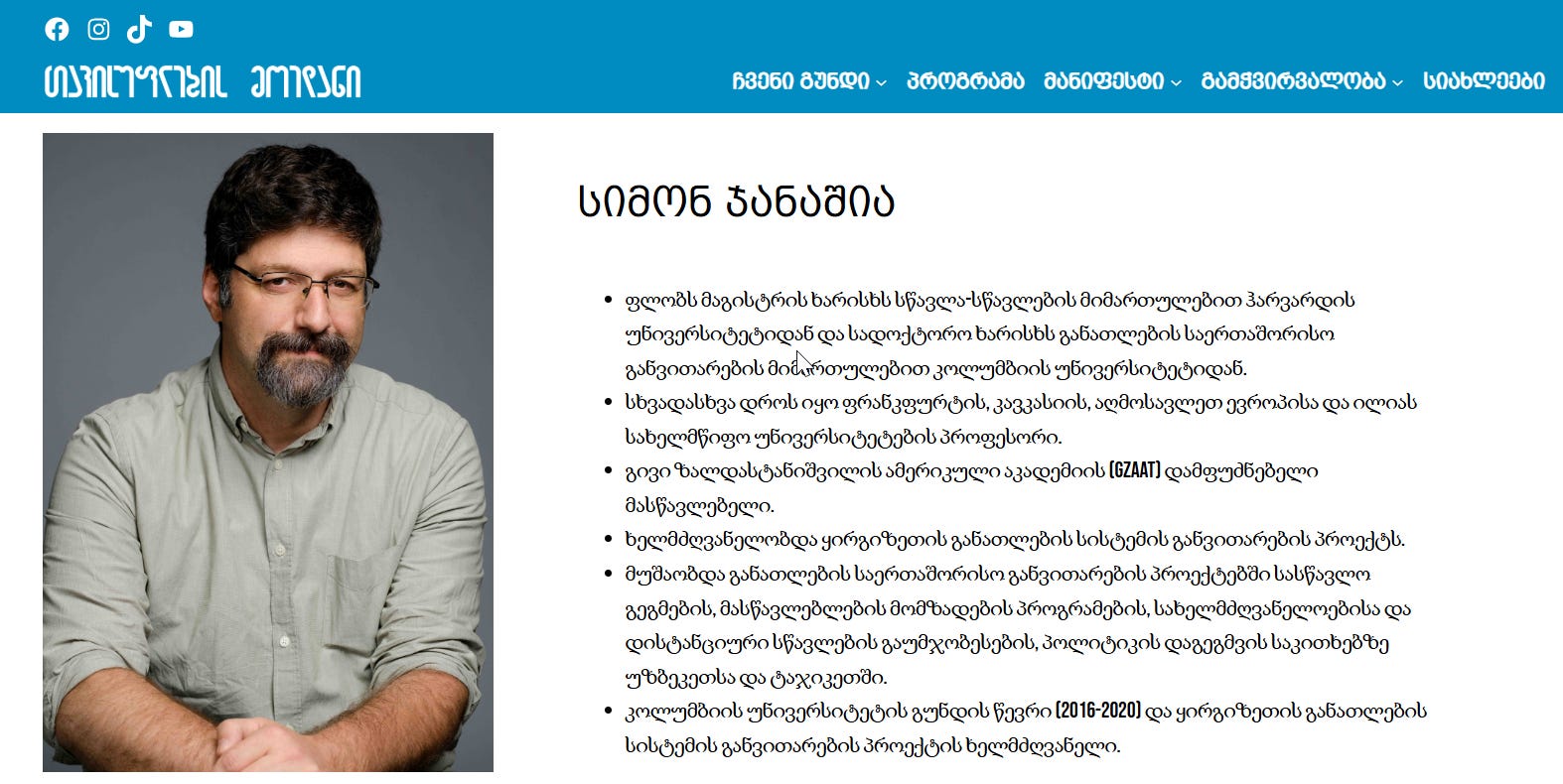
Simon Janashia has been working in education in various capacities for 25+ years, as a professor, teacher, senior civil servant, and consultant. He received his doctoral degree at Columbia Teachers College, earned his MA degree from the Harvard Graduate School of Education, and has taught history at secondary schools and at Tbilisi State University. He has been a founding teacher of Guivi Zaldastani American Academy in Tbilisi. He is on LinkedIn.
Freedom Square is a Georgian party registered in late 2025. More information about the party is at https://freedomsquare.ge/.